

Understanding the Basics: What Does “Emigrate vs Immigrate” Mean?
When people talk about moving across borders, they often hear the terms emigrate and immigrate. Although both involve relocation, the perspective each word adopts is different. “Emigrate” looks at the departure from the home country, while “immigrate” focuses on the arrival in a new land. Recognizing this shift in point of view is the first step toward mastering the phrase “emigrate vs immigrate.”
Both verbs belong to the broader family of migration terminology, yet they are not interchangeable. Using the wrong term can change the meaning of a sentence and may even affect legal interpretations in immigration paperwork. By the end of this guide, you’ll be able to choose the right word every time you write or speak about cross‑border movement.
The confusion often stems from the fact that English speakers treat “migration” as a single concept, ignoring the subtle directional nuance each verb carries. In everyday conversation, the mistake is harmless, but in academic, legal, or professional contexts, precision matters. Let’s explore the definitions, grammar, and real‑world applications in depth.
Definition of Emigrate
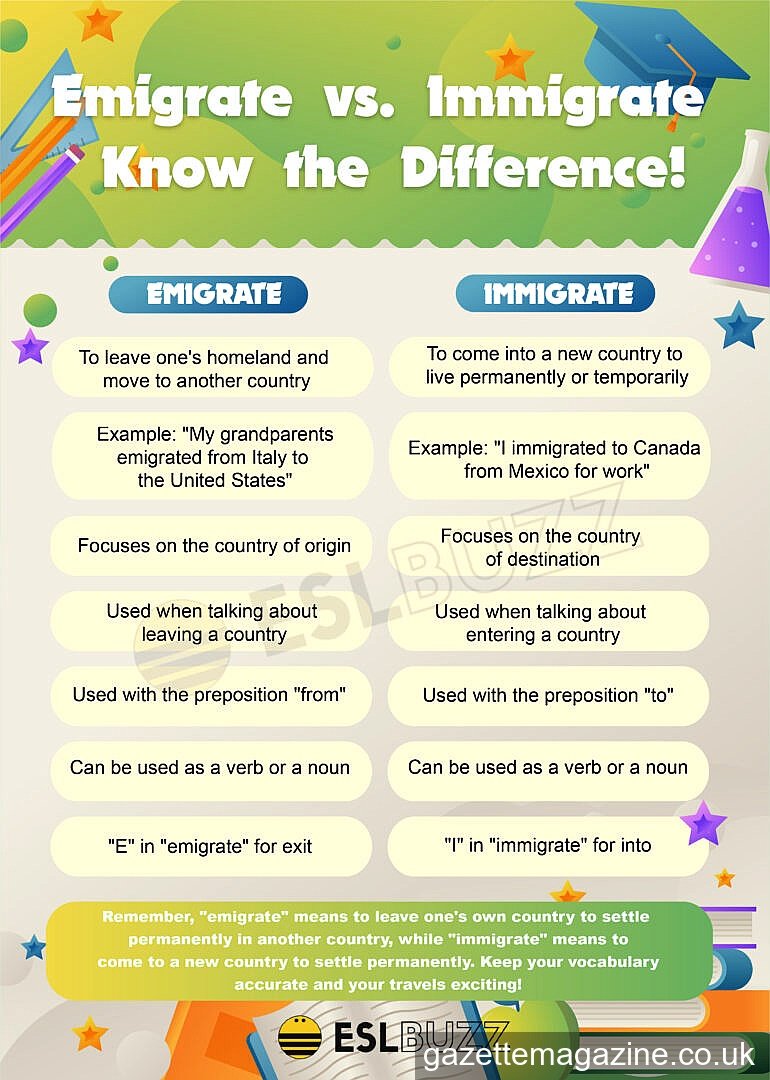
To emigrate means to leave one’s country of origin with the intention of settling elsewhere. The subject of the sentence is the person or group departing, and the focus is on the act of exit. For example, “She emigrated from Brazil in 2019.” The verb emphasizes the loss of residence in the original nation.
Historically, emigration has been driven by economic hardship, political unrest, or personal ambition. Nations often track emigration statistics to understand brain drain or population decline. In official documents, the term appears in phrases such as “emigration permit” or “emigration records,” reinforcing its outward‑looking perspective.
In grammar, “emigrate” pairs with prepositions like “from” to indicate the origin. The sentence structure typically follows: subject + emigrate + from + country. This pattern helps writers keep the focus on the departure point, which is essential when comparing it directly with “immigrate.”
Definition of Immigrate
To immigrate means to enter a new country with the intention of living there permanently or for an extended period. The subject is the newcomer, and the verb highlights the act of arrival. For instance, “They immigrated to Canada after winning a skilled‑worker visa.” Here, the emphasis is on the destination.
Immigration policies differ widely across the globe, influencing who can legally settle in a country. Terms like “immigration law,” “immigration officer,” and “immigration status” all stem from this verb, underscoring its forward‑looking orientation. Governments monitor immigration to manage labor markets, cultural integration, and demographic trends.
Grammatically, “immigrate” often partners with “to” or “into” to mark the destination: subject + immigrate + to/into + country. This structure mirrors the opposite of “emigrate,” reinforcing the idea that the two verbs are two sides of the same migratory coin.
Historical Evolution of the Terms
The roots of “emigrate” and “immigrate” trace back to Latin: emigrare (to move away) and immigrare (to move into). Both entered Middle English via Old French, retaining their directional meanings. Over centuries, the words have remained stable, which is why modern speakers still rely on the same distinctions.
During the 19th and early 20th centuries, massive waves of European movement popularized the use of both terms in newspapers and government reports. Emigration statistics from that era reveal large numbers leaving Ireland, Italy, and Eastern Europe, while immigration figures highlight the influx into the United States and Argentina.
In contemporary discourse, the digital age has revived interest in these words as people research relocation options online. Search engines now register “emigrate vs immigrate” as a common query, reflecting the ongoing need for clear explanations. This resurgence underscores the relevance of accurate language in a globalized world.
Grammar and Point‑of‑View: Why the Choice Matters
The primary grammatical difference lies in the point of view. “Emigrate” adopts the speaker’s perspective from the origin country, whereas “immigrate” adopts the perspective of the destination country. This shift influences preposition choice, verb tense, and even adjective forms like “emigrants” and “immigrants.”
When constructing sentences, remember these quick guides:
- Emigrate + from + origin (e.g., “They emigrated from Japan.”)
- Immigrate + to/into + destination (e.g., “She immigrated to Australia.”)
Using the wrong preposition can create awkward or ambiguous sentences. For example, “He immigrated from Germany” mistakenly mixes the arrival verb with a departure preposition, confusing the reader about where the action is centered.
Verb tense also follows the same logic. In past perfect, you would say “had emigrated from” to stress the earlier departure, while “had immigrated to” stresses the earlier arrival. Maintaining consistency in tense and preposition ensures clarity, especially in academic papers comparing migration trends.
Common Mistakes and How to Avoid Them
Even native speakers slip up on “emigrate vs immigrate.” The most frequent error is using the two verbs interchangeably, which erases the directional nuance. Another mistake is pairing “immigrate” with “from” or “emigrate” with “to,” leading to sentences that read backward.
To avoid these pitfalls, ask yourself two simple questions before writing:
- Am I emphasizing the departure? Use emigrate and pair it with “from.”
- Am I emphasizing the arrival? Use immigrate and pair it with “to” or “into.”
Proofreading tools often flag mismatched prepositions, but a quick mental check can be more reliable. Additionally, remember that “migrate” is a neutral term that can replace both when direction is irrelevant, such as “Birds migrate seasonally.” However, in legal or formal contexts, the precise verbs are preferred.
Finally, be aware of noun forms. “Emigrant” refers to someone who has left their country, while “immigrant” refers to someone who has entered a new one. Mixing these nouns with the wrong verbs creates double errors, e.g., “She is an immigrant who emigrated to Canada.” The correct phrase would be “She is an immigrant who moved to Canada.”
Legal and Policy Implications
Immigration law is a complex field where the distinction between “emigrate” and “immigrate” carries real consequences. Visa applications, residency permits, and citizenship processes all rely on precise terminology. An applicant who “emigrated” from a country must provide proof of departure, while an “immigrant” must satisfy entry requirements of the receiving nation.
Governments maintain separate agencies for each process: Emigration departments handle exit clearances, while immigration bureaus manage entry approvals. For example, the United Kingdom’s Home Office oversees immigration, whereas the Ministry of Foreign Affairs may issue emigration certificates for citizens leaving the country.
Statistical reports also differentiate the two. The United Nations’ migration data sets list “emigration rates” (people leaving a country per 1,000) and “immigration rates” (people arriving per 1,000). Analysts compare these figures to assess net migration, a key indicator of demographic change.
Understanding the legal nuance helps applicants avoid costly mistakes. A misused term on a form could trigger delays, additional documentation requests, or even denial of a visa. Therefore, mastering the phrase “emigrate vs immigrate” is not just academic—it can affect real‑world outcomes.
For deeper insight into how migration terminology shapes policy, explore resources that discuss the broader impact of movement on economies and societies. your natural anchor text provides a comprehensive look at related topics.
Real‑World Examples and Case Studies
Consider the Irish diaspora of the 1840s. Millions emigrated from Ireland due to the Great Famine, seeking refuge in the United States, Canada, and Australia. Those who arrived in the United States were recorded as immigrants in census data, illustrating the two‑sided nature of the migration story.
Another modern example involves tech professionals moving from India to Silicon Valley. They emigrate from India, often citing career opportunities, and then immigrate to the United States under H‑1B visas. Their dual status influences both Indian brain‑drain statistics and U.S. immigration policy debates.
In refugee contexts, the terminology becomes even more critical. A person who flees conflict in Syria emigrates from Syria, while the host country—Germany, for instance—processes them as an immigrant seeking asylum. International law distinguishes between the two phases, affecting rights and protections.
Business migration also showcases the split. Multinational corporations relocate executives who emigrate from their home offices and immigrate to new regional hubs. Companies must navigate both exit regulations (tax clearance, work permits) and entry requirements (visas, residency permits).
These scenarios demonstrate that “emigrate vs immigrate” is more than a grammatical curiosity; it reflects the lived experiences of millions across the globe. By appreciating each side, readers gain a fuller picture of global mobility.
Tips for Using the Terms Correctly in Writing
When drafting essays, reports, or blog posts, keep a checklist handy:
- Identify the perspective: origin (use emigrate) or destination (use immigrate).
- Match the correct preposition: “from” with emigrate, “to/into” with immigrate.
- Choose the appropriate noun form: “emigrant” for the leaver, “immigrant” for the arriver.
- Consider the verb “migrate” when direction is irrelevant.
Proofread each sentence for consistency. If you write “She emigrated to Canada,” the preposition signals a mistake; replace it with “immigrated.” Consistency across a document reinforces credibility, especially in academic or policy‑focused writing.
Finally, remember that the phrase “emigrate vs immigrate” often appears in search queries and SEO titles. Including it naturally in headings and body text improves discoverability without resorting to keyword stuffing. Aim for a balanced density—about five to seven occurrences in a 1,500‑word article—to satisfy both readers and search engines.
