

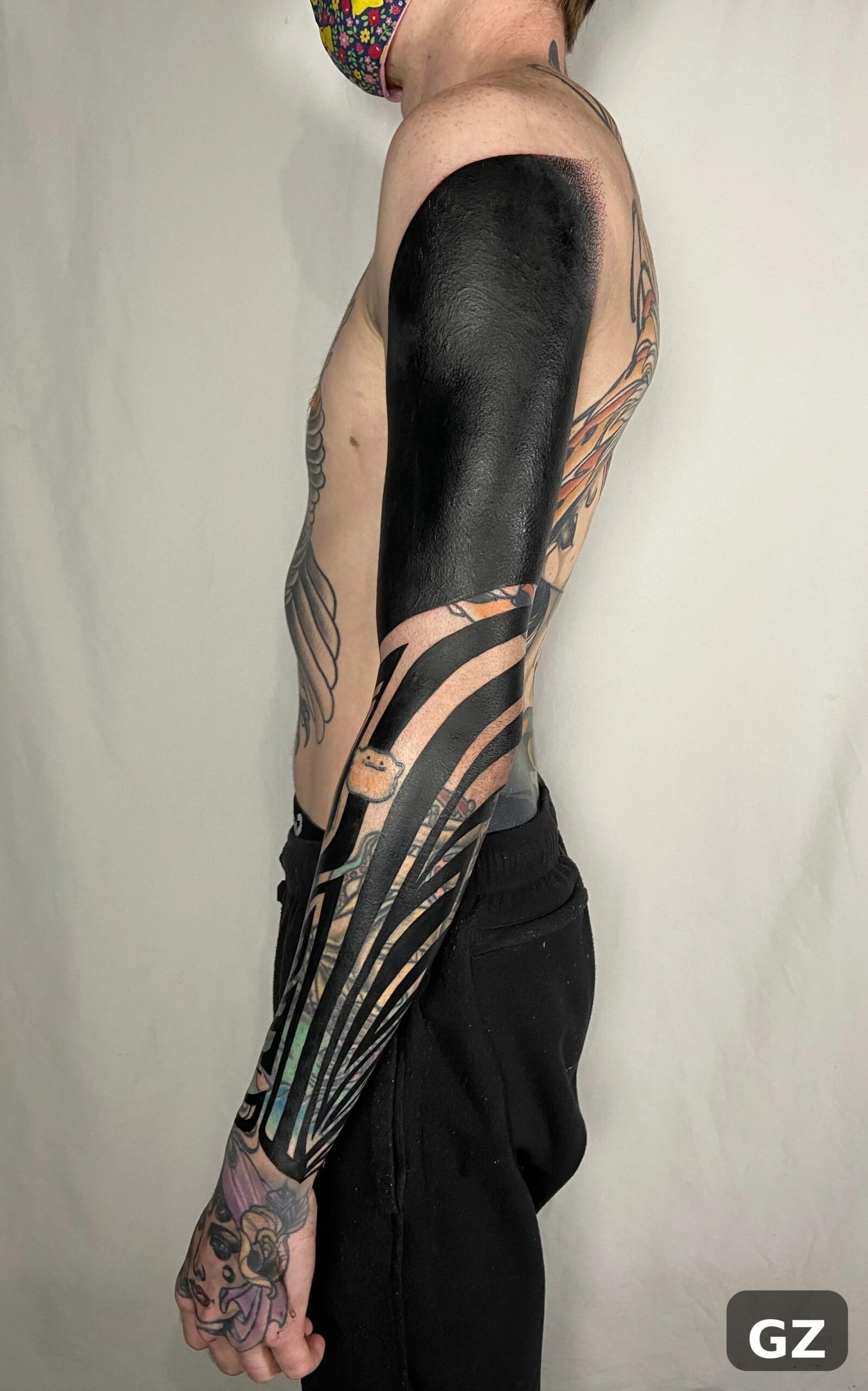
There is a moment in nearly every tattoo journey when the pieces themselves look fantastic, yet something feels unfinished. Your arm carries a dragon, a rose, a dagger and a moth — each one brilliant on its own — but between them sit pale patches of bare skin that make the whole thing read as four separate tattoos instead of one design.
That is exactly what tattoo filler is for. Far from being an afterthought, filler is the connective tissue of a great collection: the stars, smoke, vines and shading that turn a patchwork of pieces into a sleeve with flow, rhythm and intent. Ask any experienced artist and they will tell you filler is planned as carefully as any centrepiece — because it is.
In this guide you will find 40 tattoo filler ideas organised into eight themed collections, from celestial sparkle and botanicals to traditional flash and minimalist linework. You will also get a simple three-step framework for matching filler to your existing ink, practical booking and aftercare tips, and honest answers to the questions everyone asks before committing. For more style inspiration, browse the lifestyle section at Gazette Magazine.
How to Choose Tattoo Filler That Actually Works
Before you fall for a design on Pinterest, run it through this quick framework. It is what separates filler that looks intentional from filler that looks like clutter.
1. Match the line weight. This is the rule artists cite most and clients overlook most. Fine, delicate filler next to bold traditional outlines simply vanishes; heavy black filler next to fine-line work bulldozes it. Whatever line weight your existing pieces carry, your filler should echo it.
2. Let the gap shape decide the approach. Tiny slivers of skin take dots, micro-stars and small symbols. Long, narrow channels want vines, chains, smoke wisps or script. Large open areas need background approaches instead: cloud bands, wave patterns, dotwork gradients or packed black.
3. Keep one visual language. Filler should feel like the same handwriting as the pieces it joins. Japanese clouds threaded through a fine-line botanical sleeve will read as a contradiction — both styles are lovely, but mixing them in the filler layer is where sleeves fall apart.
Stars, Sparkles & Celestial Tattoo Filler
Celestial filler reads the negative space as night sky. It adds depth without mass, which makes it one of the most versatile choices in this whole list.
1. Scattered micro-stars. Tiny four-point stars placed loosely across a gap, denser near your main pieces and sparser further out. They look accidental but every placement is deliberate, and they suit almost any style.
2. Constellation lines. Dots joined by hairline-thin strokes to suggest familiar star patterns. This doubles as filler and as its own little design — a quiet payoff for a modest amount of ink.
3. Sparkle clusters. Cross-shaped sparkles of varying sizes grouped like glints of light. Ask your artist to graduate them from large to tiny so the eye travels naturally across the gap.
4. Crescent moons. Small crescents tucked into corners and curves, often paired with a star or two. The curved shape hugs wrist bones and elbow bends better than straight motifs do.
5. Shooting-star trails. A short arc of tapering dots ending in a tiny star, placed to follow the limb’s direction. It adds implied movement, which is exactly what static patchwork sleeves usually lack.
6. Mini planets and orbits. A marble-sized planet with one thin orbital ring, small enough to sit in a palm-sized gap. Best kept simple — heavy detail at this scale blurs within a few years.
Florals & Botanical Tattoo Filler
Botanical filler exists at every line weight, which is why it rescues mismatched sleeves better than almost anything else. The same vocabulary works in fine line and bold traditional.
7. Winding vines. Thin stems with small leaves that creep through channels between pieces. Vines are the most forgiving filler there is, because they follow irregular paths by nature and can be extended in later sessions.
8. Wildflower clusters. Three or more small flower shapes mixed at different heights, like a loosely gathered posy. Keep the petals small so the cluster reads as filler rather than competing with your main subjects.
9. Single-line roses. A fine-line rose outline that fills a fist-sized gap while still reading as a real subject. Match the outline weight to your surrounding work or the rose will look like it wandered in from another sleeve.
10. Eucalyptus sprigs. Long stems of small oval leaves that slot beautifully into narrow vertical gaps, such as the inside of a forearm. Minimal, modern and easy to mirror on the other arm.
11. Cherry-blossom branches. A diagonal branch with scattered petals that can stretch from wrist to elbow. The loose petals drifting off the branch fill surrounding micro-gaps for free.
12. Lavender and thistle stems. Upright, structured stems that bring a slightly wild, hedgerow feel. They suit blackwork and illustrative sleeves, and the natural verticality fits calf and forearm placements.
Dotwork, Shading & Texture Tattoo Filler
When you want flow rather than new subjects, texture-based filler is the answer. It gives the eye somewhere to travel without adding anything it has to interpret.
13. Gradient dotwork. Stippled dots that fade from dense to sparse, creating a soft grey field between subjects. It sits halfway between bare skin and solid black — tonal bridge-building without a single outline.
14. Whip shading. Long, sweeping tapered lines that build grey value through movement rather than stipple. It has an organic, brushed feel that suits black-and-grey realism and portrait work.
15. Smoke wisps. Soft grey smoke drifting between pieces with no hard outlines anywhere. This is the quietest connector on the list, and it belongs in dark, atmospheric sleeves where outlined filler would fight the rendering.
16. Brushed gradient fades. Smooth black-to-skin gradients painted in behind existing pieces, like a vignette. It makes older pieces read stronger through contrast, though it commits you to a darker overall composition.
17. Stippled mandala shading. Partial mandala patterns rendered entirely in dots, cropped by neighbouring tattoos or the edge of the limb. The radial structure creates anchor points where the eye can rest.
Script, Words & Symbolic Tattoo Filler
Lettering and symbols carry meaning in tiny footprints, which makes them ideal for gaps that are too small for imagery but too big to leave empty.
18. One-word script. A single meaningful word in fine script — breathe, steadfast, maman — curved to follow the gap’s shape. Keep it short: long phrases need larger text to stay legible over time.
19. Roman numerals. A date that matters to you, set in classic numerals along a wrist, collarbone or ankle. Clean, timeless and sized to fit almost anywhere.
20. Tiny crosses. Minimal cross outlines scattered sparingly between pieces. They are among the simplest gap fillers ever devised and they never look dated.
21. Initials in a ribbon banner. A small traditional-style banner carrying one or two initials, slipped into a horizontal gap. A nod to classic tattoo flash that fills space efficiently.
22. Zodiac constellations. Your sign — or the signs of people you love — rendered as the actual star pattern. Personal, subtle, and it earns its place as filler while meaning something real.
Traditional & Neo-Traditional Flash Tattoo Filler
The old-school flash sheet is essentially a catalogue of gap fillers. These motifs were designed a century ago to sit between larger pieces, and they still do the job.
23. Classic dagger. A small bold-outlined dagger angled to follow the limb. It fills a surprising amount of space for its size and brings instant traditional credibility.
24. Swallow in flight. A compact swallow with swept-back wings, placed as though circling a larger piece. The shape slots into awkward triangular gaps that nothing else quite fits.
25. Lightning bolt. A jagged bolt in solid black or yellow flash, small enough for tight spacing. It is one of the most requested micro-fillers in traditional shops for good reason.
26. Spiderweb elbow. The classic solution for the elbow’s awkward dome. Webs are designed for curved, bony areas — they look wrong on flat skin and perfect on the point of the elbow.
27. Panther head. A small crawling-panther head with bared teeth, a traditional staple that fills a palm-sized space with pure attitude. Best in bold colour or black-and-grey to match surrounding work.
Creatures & Critters Tattoo Filler
Small creatures bring life and movement to a sleeve. They read as charming rather than structural, which suits patchwork collections with a playful streak.
28. Butterfly trio. Three butterflies at different sizes, wings angled differently so the eye travels between them. Group them loosely rather than in a row — nature never lines things up.
29. Resting moth. A small moth with patterned wings, slightly more gothic than a butterfly. It suits blackwork and fine-line sleeves and fills a coin-sized gap beautifully.
30. Mini snake. A slender snake curving through a narrow channel, head raised. Snakes follow irregular paths naturally, making them excellent gap-fillers as well as standalone motifs.
31. Ladybird on a leaf. A tiny ladybird perched on a single small leaf. Sweet, quick to tattoo, and it tucks into corners that larger motifs cannot reach.
32. Koi minis. Small koi rendered in the Japanese style, scaled down to fit between larger pieces. They carry the movement and flow of full-size koi work in a fraction of the space.
Geometric & Linework Tattoo Filler
Geometry gives an organic sleeve a structural spine. It works best when your arm already contains at least one geometric element to rhyme with.
33. Thin orbital arcs. A few clean concentric arcs sweeping across a gap, like ripples or orbit lines. Elegant, modern and almost impossible to get wrong in placement.
34. Hexagon fragments. Partial honeycomb patterns cropped by neighbouring tattoos, so they look like a structure continuing underneath. A little goes a long way — keep the fragment small.
35. Ornamental swirls. Filigree-style curls borrowed from jewellery and engraving, flowing between pieces. They bridge fine-line and illustrative work without introducing a new subject.
36. Micro-mandala. A palm-sized mandala with genuine radial symmetry, used as an anchor between busier pieces. Only book this with an artist who specialises in geometric work — wobbles show instantly.
37. Chain links. A short run of fine chain draping across a gap, following the limb’s curve. It has a jewellery-like quality that suits delicate sleeves and wrist-to-forearm transitions.
Minimalist & Negative-Space Tattoo Filler
Sometimes the bravest filler is the quietest. These ideas preserve breathing room while still connecting the composition.
38. Dotted seam lines. A soft dashed line stitching two tattoos together, like a seam. It stays invisible until you look for it, which is precisely the trick.
39. Continuous-line flourish. A single unbroken line looping through the gap in one elegant gesture. Ask to see the artist’s freehand linework first — this lives or dies on confidence.
40. Tiny hearts row. Three small hearts in a gentle arc, nothing fancy. Ten minutes per heart, endless usefulness, and they look as good solo as they do in sequence.
Tattoo Filler Tips: What to Know Before You Book
Filler sessions are usually shorter and cheaper than centrepiece sessions, but they still deserve proper planning. A dedicated filler consultation — where your artist maps the gaps with a marker before any needle touches skin — is the single best investment you can make. Bring photos of your existing work healed, not just fresh, because ink settles and softens over months and your filler needs to match the healed reality.
Be honest about the future. If you plan to add more large pieces, leave the biggest gaps open and fill only the small ones; once packed black or dense dotwork goes in, anything added later has to sit on top of it. Pain-wise, filler often lands on the spots artists and clients both dread — the elbow ditch, the inner wrist, the soft skin above the knee — so expect these sessions to sting more than the size suggests.
Aftercare matters more than people expect in creases and bends: filler near the elbow or wrist heals slower and needs extra moisturising and sun protection. And one cultural note worth taking seriously — geometric tribal patterns, including Filipino batok designs, carry deep heritage meaning. If you are drawn to them, research the tradition and choose an artist trained in the practice rather than borrowing the look.
Do tattoo fillers hurt more than the main pieces?
Not the design itself, but the placement often does. Filler tends to land in the leftover spots — the elbow ditch, inner wrist, armpit edge — which are among the most sensitive areas to tattoo. Small size does not mean low pain here.
Can filler go over or around old tattoos I regret?
Around, yes — clever filler can visually rescue a tired piece by reframing it. Over is harder: only dense blackwork or blackout truly covers old ink, and laser fading first gives far better results than trying to bury a tattoo under filler.
How much does tattoo filler usually cost?
Most shops charge their hourly rate, and small filler pieces typically take 30 minutes to two hours. Background work like clouds, dotwork gradients or packed black across a large area is priced like any large session — expect several hundred pounds or dollars per sitting.
How long should I wait between tattoos before adding filler?
Wait until each neighbouring piece is fully healed — at least four to six weeks — before filling around it. Judging tone and spacing through swollen, fresh skin leads to filler that looks wrong once everything settles.
Will tiny stars and dots blur over time?
Very fine micro-detail softens over the years; it is the nature of ink in skin. Stars with slightly bolder points and dots with a little breathing room between them age far better than ultra-tight clusters. Always ask to see the artist’s healed photos of similar work.
Should I fill gaps now or wait until my sleeve is fully planned?
Fill small gaps whenever you like, but keep large areas open if you are still collecting centrepieces. The most common regret artists hear is a sleeve boxed in by premature filler, leaving no room for the piece the client fell in love with a year later.
The Bottom Line
The best tattoo filler ideas are the ones you barely notice — the stars that make a gap read as sky, the vine that tricks the eye into thinking two unrelated pieces were always one story. Choose filler that matches your line weight, respects the shape of the gap and speaks the same visual language as the ink it joins, and your collection will finally read as the single piece of art it was always meant to be.
